Approximately Up Map: All Planets & How to Land on the Moon
Approximately Up map of all planets: how to land on the Moon, where Pandora the water planet is, and where to go after the Moon (checked Sep 1, 2026).

Approximately Up has 15 unique planets, and the Moon is the first one players actually reach after Earth. The community’s landing method is the reverse burn: fly past the Moon, flip around, and brake down to roughly 800-1,200 m/s before touching its thin atmosphere. Aundara, the planet behind most “where is Aundara” threads, is a small dark grey-brown body on the Moon’s far side, about 22 minutes away at ~65 km/s with medium electric thrusters. Baobara is the ringed planet whose lit-side baobab valley hosts the interference-signal mission — descend when the signal reads ~0.0034.
Version note: planet count, distances and route safety on this page were verified on August 13, 2026 against patch 1.0.010, the latest confirmed release note.
The 15-Planet Roster: What Is Actually Confirmed
The store page officially lists 15 unique planets, each with its own size, gravity, atmosphere, temperature and challenges, plus a dynamic soundtrack per planet (Last checked: August 13, 2026). A March 2026 demo-era news post said the release “should have 17 planets”, but the store page is the source of truth: 15. The demo only let players reach Earth and the Moon, so demo-era “how many planets?” threads described a two-planet slice of the final game.
Planets and locations confirmed across community threads and patch notes: Earth (your starting base), the Moon, Aundara, Baobara, Basalt, the sun and a red dwarf star, and the Void Watcher base from patch 1.0.009. Baobara is ringed, with a baobab-filled crater valley on its lit side. Two more names, Marretti and Helirion, appear in early planning threads but could not be re-verified — community-mentioned, not confirmed. The complete official 15-name list is not yet confirmed — it has not been published anywhere we can verify — and what comes after the Moon missions is also not yet confirmed.
The demo-period water planet from Fred’s Quest was a limited-time event location and is not part of the 15. Planet Stations are the checkpoint system: each is a save point and garage, and landing once permanently unlocks that planet as a new departure point. Get a working ship first — getting-started covers the build. Once you have one, the route planner keeps every confirmed destination, trip number and landing note in one checked table.
The Scarlet Seeker’s 1.0 overview confirms the zoomed-out map shows many planetary bodies, with the first missions as courier/delivery runs on Earth — pick up cargo, make sure it fits and the cabin is sealed. A further water planet is smaller and farther out; a mission delivers a submarine rated to 5,000 m depth, with floodlights and ballast as unlocks.
Release Missions Beyond the Moon
SaNT xc’s launch-week livestream (release build, August 8, 2026) walks through the Moon’s missions and what comes after. The Moon has a “big battery problem” objective: find and retrieve the lost large disposable battery from the Moon’s dark side. Another is a thruster test — deliver a new experimental electric thruster from the Moonstep base to the Under Prime base on Aundara, and if it works well you get to keep it. The same stream calls the ring planet (Baobara) the next destination after the Moon, and players call the water planet “Pandora”. It also shows a hidden Easter egg: a drum kit inside Earth headquarters, hinted at in Earth mission text, reachable in Fly Mode.
Where to Go After the Moon
Finish the Moon’s two known missions — the dark-side big-battery recovery and the Moonstep-to-Under-Prime thruster test flight — and the next destinations are the ringed planet Baobara and Aundara with its Under Prime base. The water planet players call “Pandora” lies further out: a submarine-delivery mission sends you there, and completing it unlocks floodlights and ballast for the sub. SaNT xc’s launch-week livestream (release build, August 8, 2026) walks through all of this.
Community flight times from the same stream: Moon to Aundara took one player up to 2 hours in a slow ship and about 20 minutes in a fast one before patch 1.0.005 shortened the distance; with the Brake System (BPS) the run drops to about half an hour, and bigger engines are always faster.
Gravity, as the stream explains it: roughly 0.3 g near a planet and zero in deep space, with a gravity meter unlocking later. On approach the objective base blinks on the map/radar, and about 2,000 is the safe reference altitude to cut thrust before entering the atmosphere. The landing itself is covered in How to Land on the Moon below, and Baobara’s signal mission comes further down.
Solar Storms and Route Safety
The sun and the red dwarf star are heat hazards — a ship caught in a solar storm on a close route can burn. Patch 1.0.008 (August 10, 2026) tuned the best-known route — the Moon-Basalt leg is now about 99% safe from solar storms. The developer’s own note leaves a tiny residual chance, so read it as “almost never, not never” (Last checked: August 13, 2026).
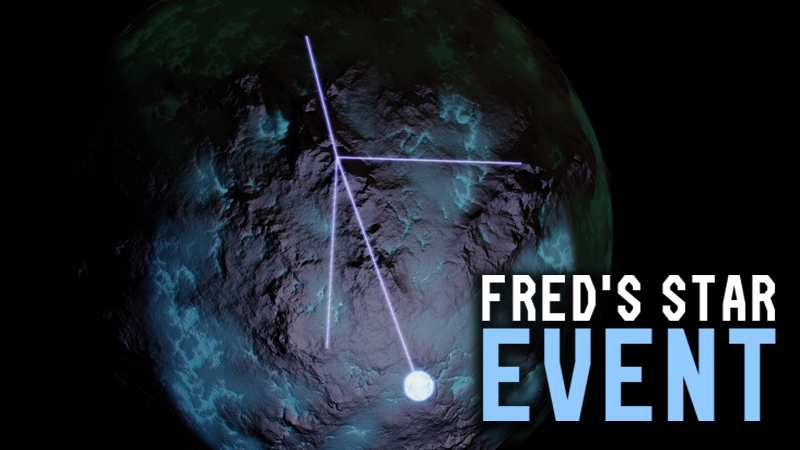
Fred’s Quest and Fred’s Star were demo-era limited events — the art above is Fred’s Star’s blue-star finale. Whether the sun itself or a black hole can ever be reached is not yet confirmed — in the demo they were background objects only. The Void Watcher base is confirmed by patch 1.0.009, but its route and requirements are not yet confirmed. The game hotfixes almost daily, so route numbers like the 99% figure can change in the next patch.
How to Land on the Moon
Universal advice for the Moon: never fly straight at it at full speed. The standard pattern: accelerate for the first half of the trip, then burn in reverse for the second half — one player’s rule of thumb starts reverse thrust at about 5,000-6,000 m/s. Cross the Moon’s thin atmosphere at no more than roughly 800-1,200 m/s, and if you overshoot, pass above the Moon and drop into a low orbit before descending. The music changing as you close in is the braking cue: when the soundtrack shifts, slow down. Low over the surface, fans and atmosphere engines work again for the final hover.
The most common Moon complaint is darkness: landing on the unlit side means flying blind, and players report those approaches end in crashes. The fix is to route toward the lit side and find the Moonstep base there first. A community workaround: fit reverse thrusters and lean on the music-switch timing above.
The Scarlet Seeker’s 1.0 overview confirms the Moon must be reached by eyeball the first time — there is no long-range meter yet — and that the Moon delivery is a frozen machine that must not lose its battery charge mid-flight; completing the Moon unlocks a brake-detector system (a relative accelerometer plus a directional laser range-finder readout). A four-player crew’s approach: VTOL lift, forward thrust, angle up until the angle to gravity reads zero, interstellar thrust as the atmosphere thins, throttle down once it hits zero, eyeball the halfway mark, flip 180 and reverse-thrust to land. Their first attempt flipped at 8,000 speed and overshot — the planet gets big fast — so flip earlier, around 5,000. Night landings are very dark; external lights or beacons help a lot.
Diggrok’s demo-era “Moon Landing Tutorial” adds: in the demo, atmospheric thrusters did work on the Moon — it has a thin atmosphere and trees — while electric/ion thrusters are required in space, and Moon-side atmospheric thrust stopped working above roughly 5,800 altitude. Radar flips from Earth radar to Moon radar as you approach. Aim at the Moon’s light side — the base is there, so an overshoot misses the Moon — climbing to about 6,000 speed, cutting atmospheric thrust; after the first Moon mission the demo unlocked an infinite-range distance meter to gauge the halfway point.
The Moon Is Fictional: Water, Trees, and Mammoths
New players keep asking why the “Moon” has lakes, trees and mammoths: it is not Earth’s Moon, but a fictional planet in the game’s star system, and those features are deliberate setting. The “Moon has atmosphere?” question gets the same answer — yes, but extremely thin, and it exists to make landings survivable.
Completing the climate anomaly mission at the Moon base — a climate bomb task — changes the world permanently: the water disappears and the atmosphere improves. One of the Moon’s stranger missions is catching a mammoth: you need a medium-size Gate part and press T repeatedly right in front of the animal’s face. Mission parts like the Gate and electric thrusters are covered in parts-and-instruments.
Where Is Aundara (and How Long Does It Take)
Aundara is the most-asked-about planet in the discussion hub, behind “Where is Aundara?” and “Can’t get to Aundara” threads. It sits behind the Moon: head toward the far side, and Aundara is the small dark grey-brown world you aim for out there. At roughly 65 km/s a direct flight takes about 22 minutes, and players recommend medium electric thrusters — granted by the mission, they stay on your ship after landing.
Patch 1.0.005 (August 7, 2026) shortened the Moon-Aundara distance from 115M to 95M to cut flight time (Last checked: August 13, 2026). The braking problem: the standard long-range rangefinder does not reach far enough, so the community trick is a zoom-capable camera aimed at the planet until the rangefinder locks, plus a crosshair drawn on your monitor to hold the aim. Land at its Planet Station and Aundara unlocks as a new departure point.
DeshyC’s “How to Find Aundara” (release build) adds the takeoff routine: start from Earth or the Moon and lift just barely out of the atmosphere — you know you are out when the altimeter reads infinite. Reduce thrust a little and scan the planet’s edge; clouds block the target until you are high enough, and climbing higher drifts you off-target.
A second release-era route comes from Jight’s Steam guide “How to find Aundara (from moon)”: with front and below-facing cameras, aim at the guide’s reference building and climb until Earth appears; fly toward Earth and roll right (clockwise) about 45 degrees so the shadow matches the guide image; watch the down-facing camera for a small dot — that is Aundara — tilt the ship downward to line up and boost.
Baobara’s Rings and the Interference Signal Mission
Baobara is the ringed planet players ask about next. Its signature landmark is a crater valley on its lit side filled with baobab trees. The mission that sends you there is an interference-signal hunt: fly around the planet while the signal strength climbs, and when the reading reaches roughly 0.0034, descend. The signal source is in the lit-side baobab valley.
After Baobara, the natural next stops are Basalt or a planet nearer the sun — subject to the solar-storm rules above. Players describe the signal hunt as one of the better navigation puzzles because it forces slow flying and instrument reading instead of pointing at a marker.
Community Guides Worth Watching
- Diggrok — “Moon Landing Tutorial” (Mar 4, 2026, ~39k views): reverse-burn method, demo-era.
- Alpha Archonek — “How to Actually Reach the Moon (Without Overshooting)” (Mar 26, 2026): overshoot-and-recover pattern.
- QuakeC — “How to get to the moon and back” (May 21, 2026): round-trip planning.
- DeshyC — “How to Find Aundara” (Aug 7, 2026): recorded right after launch on the release build.
- Wappo — “Where is Aundara?” (Aug 12, 2026): newest Aundara routing guide.
- Ghgh (RU) — “Система автоматической посадки для новичков” (Jun 15, 2026): beginner auto-landing system build.
Mind the dates: videos from before August 6, 2026 show the demo build, and near-daily hotfixes keep adjusting numbers (latest verified: 1.0.010, August 12, 2026).
- Related: Aundara guide — full trip guide and Under Prime missions.
Baobara, Moon Rewards, and Storm Clarity (1.0.104 / 1.0.100)
Patch 1.0.104 ties new instruments to existing destinations: complete Tree Lid on Baobara for a Space GPS, and Operation Ghostfire on the Moon for 3× Massmeter. The Baobara Interferencemeter now reads distance to the interference source instead of a 0–1 gauge, and the What Happened To Baobab mission text was updated. A new in-game manual page explains Solar Storms and how to tell when you enter the deadly zone. Patch 1.0.100 also slightly weakened solar storms overall and improved Long Range Distance Meter precision for tiny distant worlds. Patch 1.0.105 fixed jumping on airless planet surfaces after earlier movement changes.
Sources
Verified August 13, 2026.
- Steam store page: https://store.steampowered.com/app/3904850/Approximately_Up/ (official — planet count and Planet Stations)
- Steam News: https://steamcommunity.com/games/3904850/announcements/detail/1840310314344927 (1.0.005 Aundara distance), https://steamcommunity.com/games/3904850/announcements/detail/1840310314351624 (1.0.008 solar storm tuning), https://steamcommunity.com/games/3904850/announcements/detail/1826362059928864 (17-planet statement)
- Steam discussions (player reports): https://steamcommunity.com/app/3904850/discussions/0/588434434320097169/ (Aundara route), https://steamcommunity.com/app/3904850/discussions/0/588434434320126925/ (rangefinder trick), https://steamcommunity.com/app/3904850/discussions/0/563659628006668703/ (Moon landing), https://steamcommunity.com/app/3904850/discussions/0/588434705716673010/ (dark side), https://steamcommunity.com/app/3904850/discussions/0/588434434319999838/ (Moon water/climate), https://steamcommunity.com/app/3904850/discussions/0/588434705716611220/ (Baobara signal), https://steamcommunity.com/app/3904850/discussions/0/588434434320053738/ (mammoth), https://steamcommunity.com/app/3904850/discussions/0/588434434320227741/ (roster)
- Steam Community guides: https://steamcommunity.com/sharedfiles/filedetails/?id=3780928995 (Jight — How to find Aundara from the moon)
- YouTube (community guides): https://www.youtube.com/watch?v=oKIN1Is_-jc (Diggrok), https://www.youtube.com/watch?v=Fn7Nw2npMuE (Ghgh RU) , https://www.youtube.com/watch?v=o8UyGVgf4_g (DeshyC), https://www.youtube.com/watch?v=DLZtIqyiVvY (The Scarlet Seeker) , https://www.youtube.com/watch?v=EPaH2IL3sNo (SaNT xc livestream)
- Images: official Steam news headers and official Steam store screenshots for Approximately Up.
Fan-made guide. This site is not affiliated with Approximately Games, Steam, or Valve; all game content and media belong to their respective owners. Factual details were last checked on August 13, 2026.